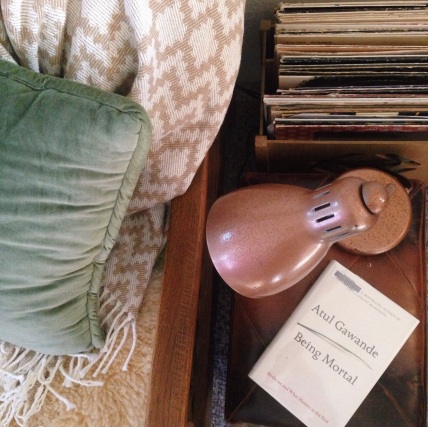
Being Mortal: A Book You Should Read

Processed with VSCO with c1 preset

“Our ultimate goal, after all, is not a good death but a good life to the very end.”
― Atul Gawande, Being Mortal: Medicine and What Matters in the End

When I was fourteen I fed patients pureed meatloaf one spoonful at a time on the long-term care floor of a large urban hospital. The smell of packaged, thickened split pea soup will stay with me forever, as will my first moments of connection as a care-giver. What I also remember was the deep frustration and loss of autonomy that swirled around the diet warning labels on each chart, the bed rails safely up and locked, and the DO NOT AMBULATE signs posted above the beds. At the time, I didn’t recognize the anger that was often directed at me as a symptom of that loss. I just saw a stubborn elderly man who wanted to drink his morning tea without the thickening power we were required to stir in to prevent aspiration. His safety was a priority (and a liability) of the hospital, his doctor, his nurse, and myself, couldn’t he understand?

Since that early experience, I have cared for people of many ages as they lost the health and autonomy that often naturally precedes the end of life. I discovered that modern medicine, with its emphasis on safety and prolonging life as long as possible, often runs roughshod over the intangible uniqueness of the individual.

Last spring I read Being Mortal by Atul Gawande, and sat in my recliner during nap times, yelling “YES!” in my head while I turned the pages.

“A few conclusions become clear when we understand this: that our most cruel failure in how we treat the sick and the aged is the failure to recognize that they have priorities beyond merely being safe and living longer; that the chance to shape one’s story is essential to sustaining meaning in life; that we have the opportunity to refashion our institutions, our culture, and our conversations in ways that transform the possibilities for the last chapters of everyone’s lives.” ― Atul Gawande, Being Mortal: Medicine and What Matters in the End

I put off reading this book because a piece of grass laying on a white page looks silly, not fascinating, to me. Also, a book about death? Not when I’m nursing a newborn, thanks. However, Gawande, a physician and surgeon, is insightful and engaging as he advocates that treating death as one more clinical problem often takes away the meaning and value of life as it ends. He writes clearly and weaves knowledge and insight between stories and personal experience. Instead of it being heavy, this book reads like a curious quest to discover what people really value in their lives and how we can help them keep those things as long as we can.

This was the book I wanted to give everyone to last year, but I’m not rich enough to buy a whole box of hardcovers and give them out for free. I do know someone in real life who did buy a whole box to give away to all their siblings, so you could do that too. If you read about books online you have probably already heard about or read this book, but in case any of my readers have not, I thought it worthwhile to recommend.

This book is not written from a Christian perspective, for readers who share my faith, but the concept of having a purpose larger than oneself and finishing life well are emphasized.

“The problem with medicine and the institutions it has spawned for the care of the sick and the old is not that they have had an incorrect view of what makes life significant. The problem is that they have had almost no view at all. Medicine’s focus is narrow. Medical professionals concentrate on repair of health, not sustenance of the soul. Yet—and this is the painful paradox—we have decided that they should be the ones who largely define how we live in our waning days.” ― Atul Gawande, Being Mortal: Medicine and What Matters in the End

Most of us will become caregivers at some point and all of us will face end of life decisions for those we love and for ourselves. If we are not at one of these junctions presently, most likely we know someone who is. This book talks how to honor what people value in life and  help them trade what they are willing to give up to keep the things they hold most dear. Compassion and honor would seem intuitive as we interact with those in their final years, but our own fears and concern for health and safety can hijack our empathy and cause us to override the wishes of those we are caring for. This book will decrease the chances that you will do that and give you more compassion for yourself and those you care for.

* I do ask that you do not read this review and go buy this book to give your terminally ill friend. I hope I don’t have to explain how insensitive and unhelpful that would be.
Follow my blog with Bloglovin

33 weeks and facing the fear

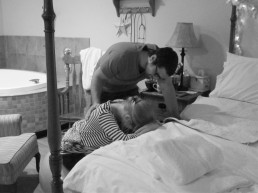
labor photo

33 weeks

Tuesday, March 8, 2016

A few months ago I read over the labor and delivery notes from a hot July day in 2014. I had my midwife print them out for me so I would never forget the details.

The notes are cryptic, medical, and to the point. It doesn’t mention the exhaustion on my face as I neared the end after five days of labor. It doesn’t note the wry smiles as Justin and I passed sarcasm and jokes between contractions. There is no mention of the deep place I went as each contraction came or of the limp relief when it left. It can’t hold more than the bare details; fetal heart rate, position of baby, what I ate and drank, where I was laboring. But it is enough to take me back and all those small details are there, hidden in the memories.

I don’t remember fear. I remember everything else so I know it wasn’t there

I don’t remember fear, that is, until I get to the very last few lines. Only 15 minutes, the notes declare.

There is more cryptic charting. The fetal heart rate suddenly doesn’t look good. There is mention of oxygen administered, more worrisome heart tones, and a slight urgency to the words. It is professional and you might not even notice anything too alarming as the casual reader. There are more memories there for me too, between those last few entries.  

There is no pain here. There is only fierce determination and deliberate mental calm as I used every last ounce of energy I had, after so long, to help my baby. Under all that control though, I feel a clawing fear that I don’t even allow myself to acknowledge. After Merek is born I laugh, I cry, I celebrate, and I am so exhausted I can’t even lift his beautiful little screaming self. Over the next year I celebrate how much I accomplished in those endless 5 days. I remember all the beautiful, intimate moments and how laughter got us through.

I don’t look at those few, fleeting moments of buried terror until I am nearing 30 weeks with this pregnancy.

Suddenly, they are all I can think about.

Suddenly they are causing me to catch my breath as my heart pounds and my hands feel clammy.

“Oh, hello, did you think you could pretend I never existed?”, the fear asks.

I am an oldest child. I am an idealist. I have always believed I have what it takes.

That reality of knowing I was not able to control the health of my baby undid me. I controlled it so well in the moment, but underneath was my dread and debilitating powerlessness.

For the last few months I faced that wall of anxiety and stopped short. I could see no way around. I could not face that unpredictability of life vs death again. I. could. not.

I have talked to dozens of women who have multiple children, asking them, “Did ever you face this?”

Most of them clucked sympathetically and told me, “Yes”.

“Not every time”, they said, “but before ______ was born I struggled more”

Not everyone had the same reason though. For some it was pain, the magnitude of the process, the fear of complications, etc.

The unpredictability is what they all faced in some form or another.

“How do you deal with it?” I ask.

Here the answers get even more vague and varied. Every woman had a different journey through to peace and acceptance, I found. Like birth, it seems, this is every woman’s own unique journey and they all seemed to think that the suggestions they had were not as helpful as a simple, “You will get through this too, don’t worry”. I was annoyed they could not be more specific.

They were right, of course.

I moved forward because you have to. You have no option. Weeks are flying by and the time is being accomplished that you should be delivered, to use the biblical language.

I prayed. I re-read books I thought were just a first-pregnancy necessity. I prayed. I went over all the good and beautiful things about bring Merek into the world. I laughed at all our labor jokes and looked at pictures.

Then while I did dishes and folded laundry and took Merek for walks I listened to women tell their birth stories through my ear phones. Happy ones, sad ones, easy ones, hard ones, fast ones, slow ones, and even the sad, heartbreaking ones. It was here I broke through. I followed my own unique journey through the anxiety, as I realized that birth is unique for everybody and the big, constant thing about it is that it is always, always unpredictable. Always. That’s how it’s supposed to be. I can prepare and plan and do all the right things, but I still don’t get to choose, in the end, how my story goes. Life itself is exactly like this too, we just ignore it for most of our lives, burying the fragility and unpredictability underneath daily life, cliques, and denial.

I realized that what makes labor and birth beautiful by nature is that this is one rare place in life we cannot escape that reality. It’s not the physical experience that is always wonderful or I would be excluding many, many women who feel very differently.

I think I’ve come to accept that experiencing the overwhelming power and overwhelming fragility of life all in the same moment is why most women count, in the end, birth to be a miracle, no matter what the outcome.

As I read through those notes again today, I still caught my breath as I neared the end of the page, but I didn’t feel the panic. I still remember how powerless I was, but it doesn’t make me afraid like it did months ago. I feel only wonder and joy.  

The last entry reads,

07/20/2014     16:59:08       Birth- Baby Crying

And I realized with overwhelming peace that the last entry was fully known by God before it was ever written and the next last entry, written under my name in two months’ time, is already known as well, so all I have to do is surrender.

labor 2